Data Reduction Potential Analysis (DRPA)
See What You Could Save — Before You Even Start.
Why DRPA
Benefits
How DRPA Works
Why is Data Reduction So Important For SAP S/4HANA?
Migrating to SAP S/4HANA or SAP Cloud ERP is one of the most critical transformations SAP customers face. Yet many organizations carry over too much—and often faulty—data into S/4HANA while still maintaining costly ECC systems. It’s like performing open-heart surgery on a running ERP system.
Dragging decades of legacy data ballast into new systems drives up costs, extends project timelines, and magnifies compliance risks. Traditional archiving alone is not enough. Archived data typically becomes inaccessible without the original system, forcing IT to maintain entire legacy landscapes for years—just to satisfy business users and auditors.
This not only delays cloud transformation but also exposes organizations to:
Exploding Costs
in cloud environments due to redundant historical data in HANA memory

Extended Project Risks
from data cleansing tasks that drag on for months or years

Compliance Gaps
from legacy systems falling out of vendor support

Missed Agility
as businesses struggle under the weight of unnecessary data

The Solution?
Data Reduction Potential Analysis (DRPA) with JiVS IMP offers a safe, automated way to identify and eliminate data risks before migrating to SAP S/4HANA.
The result: a faster, more cost-effective, and fully compliant transformation—powered by a lean, cloud-ready core that accelerates innovation instead of carrying legacy baggage.
Benefits of DRPA
With JiVS IMP, you can identify, cleanse, and reduce your SAP data volumes at the push of a button, turning a high-risk migration into a predictable, cost-efficient project.





Massive Cost Savings
Cut operating costs by up to 80% by decommissioning legacy systems once data is historized.
100% Historical Data, Always Accessible
JiVS ensures full, audit-proof access to 100% of your historical data — even after legacy systems are decommissioned. All information remains instantly available for audits, analytics, or operational needs, directly from SAP S/4HANA or any connected system.
Data Reduction at Scale
Move only 5–10% of relevant data into SAP S/4HANA, keeping your HANA database lean.
Accelerated Transformation
Reduce migration workloads by 50%, slash project timelines, and minimize downtime.
Compliance Guaranteed
Ensure audit-proof retention and legal validity by storing data in its original business context.
Future-proof Agility
Keep SAP S/4HANA clean and optimized for AI, analytics, and innovation through continuous rightsizing.
Sustainability Impact
Eliminate redundant systems and reduce IT’s carbon footprint by cutting energy-hungry infrastructure.
Holistic Insights
By performing detailed analyses at different levels of granularity and from different perspectives, you will gain a 360° view of your operational and historical data.
How DRPA Works
The DRPA is part of the JiVS IMP One-Click Transformation Cockpit (OCC). DRPA is divided into several clear steps to provide a clear picture of how much data can be archived, and how much needs to be transferred to SAP S/4HANA – which can be as little as 5 to 10%.
Here’s how it works:
1. Automated Diagnosis
JiVS IMP scans your SAP ECC or S/4HANA system and shows exactly how much data can be reduced, cleaned, or historized.
2. Separation of Data
Operational data is prepared for migration, while historical data is securely extracted with full business context.
3. Cleansing & Optimization
Duplicate, inconsistent, and outdated records are identified and removed; master data is harmonized.
4. Universal Access
All historized data is stored in JiVS IMP, fully accessible to business users and auditors without keeping legacy systems alive.
5. Righsized Migration
Only the lean, high-quality operational data moves to SAP S/4HANA, reducing project risk and keeping costs predictable.
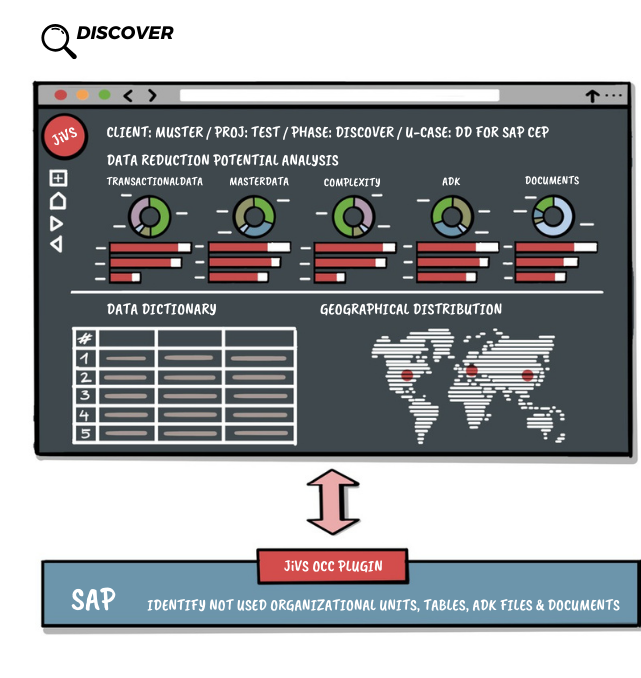
Features
- Prerequisite: System Analysis
- Business object nets displaying objects usage and volumes (#of records)
- # of customer specific objects (Z/Y tables)
- # documents per type and sizes
- # ADK objects and their size
- Standard migration objects (record, size)
- Potential customer migration objects
- Simulation capability

