
One Click
TransformationOne Click Transformation to SAP S/4HANA with just a click of a button.
Are you coming to the realization that data is the crux of your transition to SAP S/4HANA?
Are you challenged with finding the right partner to help with this challenge?
Do you need someone to help you migrate quickly and easily once and for all?
You need to explore and experience our radically new, radically simple, and patented One-Click Transformation approach.
With this patented approach, SAP S/4HANA is just a few easy clicks away from achieving a successful project resulting in operational excellence.
#1
One Click – Extract instead of migrating. With our Turbo Extractor, you can transfer your legacy data into our platform at the push of a button. From there, you only transfer the relevant data you really need in the new environment.
#2
One Click – Decommission instead of continuing to operate. After extraction, you can completely decommission your legacy systems and save massive costs – with full legal certainty.
#3
One Click – Separate instead of transforming. Our platform allows you separate the historical data from the operational data so you can process it further in SAP S/4HANA at the click of a button.
#4
One Click – Filter instead of loading. Instead of selecting and loading data at the table level, which increases risk – you can now filter and transform data for SAP S/4HANA conveniently, automatically, and without risk – all via the application layer.
#5
One Click – Access instead of Saving. With our platform, you always have 100 percent access to your historical data at the click of a button. Best of all, thanks to our simple, on-the-fly transformation, it looks exactly like the operational S/4 data in the SAP GUI or SAP Fiori.
#6
One Click – Be open instead of thinking in silos. The One Click Transformation is flexible and is open for SAP and non-SAP data, for on-premises and in the cloud.
#7
One Click – Optimize instead of manually reworking. Data-driven enterprise needs master and transactional data in optimal quality – cleansed, enriched and harmonized. With our patented platform, this can be done at a click of a button.
#8
One Click – Start today instead of tomorrow. Our platform helps you lay the critical foundation needed today for the data fabric forefront of tomorrow. Ensure you have the proper framework for a flexible, data-driven, and intelligent enterprise.
#9
One Click – The path is the goal. Our One Click Transformation separates the data layer from the application layer consistently, once and for all. This ensure you have a clear path forward for continuous optimization of your digital enterprise and transformation.

What is the One Click Transformation Approach?

Hawle’s Journey to SAP S/4HANA in Just Three Months
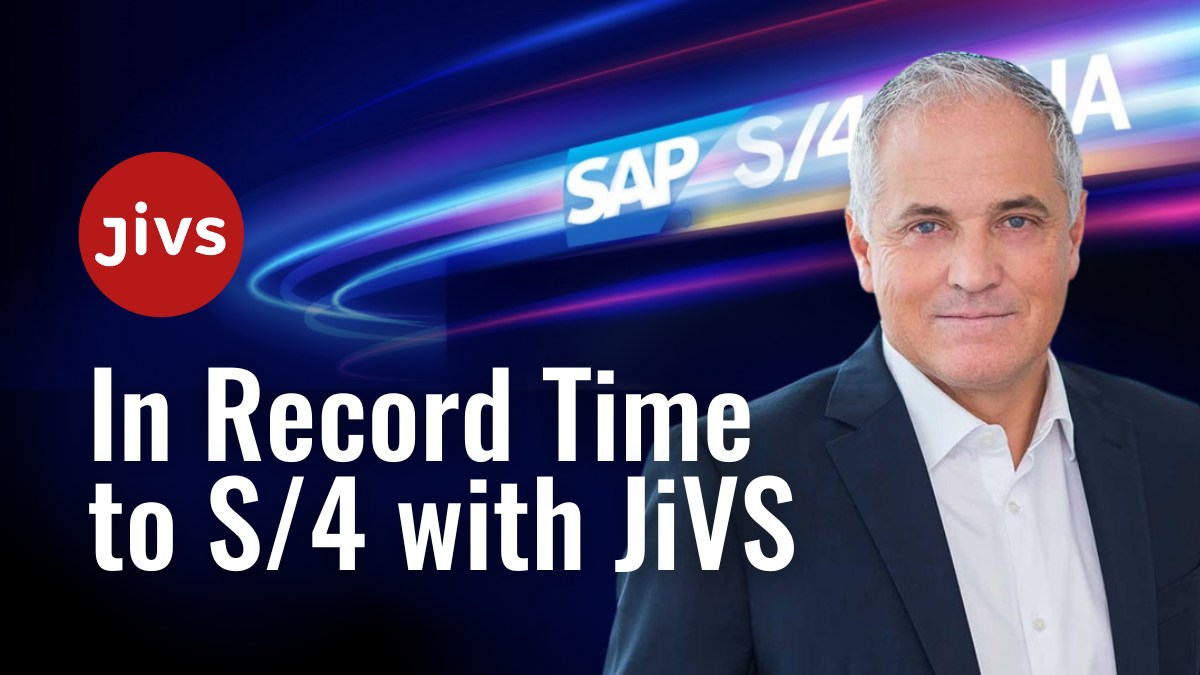
In Rekordzeit nach S/4HANA mit JiVS (German)
Ready to get started to transform your business?
Fill out the form below to start your automated transformation journey with our patented technology for information management JiVS IMP.
Problem description
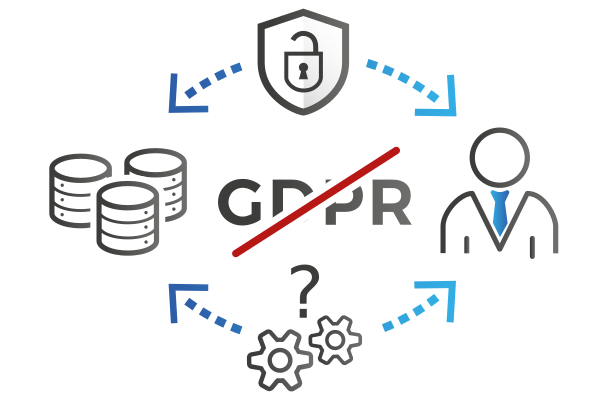
2027 – or 2030 if customers opt for Extended Maintenance. That’s when SAP is ending support for all versions prior to SAP S/4HANA. This implies a mammoth project for most established SAP customers, because this is no ordinary upgrade – it’s more like a completely new implementation. The biggest challenge from both the complexity and time perspectives is the migration and transformation of existing data and documents to the new environment.
Read more
Moving multiple heterogeneous legacy systems, typically not from one single manufacturer to a new centralized and modern solution inevitably entails data migration projects. The associated workload for large companies very quickly adds up to 5,000 man-days and more. The better the data quality and smaller the volume of migrated information is, the greater the benefits of data migration are. Duplicates, incomplete or erroneous data records, such as those concerning long-sold or closed parts of companies and business units, already cost storage space and maintenance in the legacy systems. A new and central solution’s potential to create value is reduced accordingly if these legacy issues are also transferred to the new environment. SAP has also recognized the challenge of historical data and documents when companies are transforming themselves into an “Intelligent Enterprise”. This is why the Walldorf-based firm – within the framework of its SAP Movement program for faster implementation of SAP S/4HANA or SAP C/4HANA – recommends meeting this challenge. It advises companies to undertake an intelligent –meaning selective – transfer of historical information to the new environment and treat it from the outset as part of the transformation project.
Repercussions
Established SAP customers who have planned or already started the migration to the new software generation are soon faced with a massive drain on financial and staff resources, as large SAP installations comprise many terabytes of data. Another aspect is that they may need to make significant investments in the new infrastructure required for the implementation of SAP S/4HANA.
Read more
In addition, customers’ existing data pools unavoidably contain multiple incorrect data sets that have been building up over the years. If customers were to undertake a full migration without cleaning these data sets beforehand, the data would be transferred to the new environment – a significant and even unacceptable risk for the digital business processes and models of the future.
New business models, such as those based on the Internet of Things (IoT), are even at stake if sensors and machines are assigned to the wrong customer data. The opportunity in centralization and modernization projects, however, lies precisely in not transferring all legacy data and documents, but just the up-to-date and correct information that is really needed.
The migration of existing data pools to SAP S/4HANA or SAP C/4HANA also requires their transformation as the database structures are different. This generates potential problems with internal audits and external checks. Who is able to guarantee that no data was changed during the
Impact
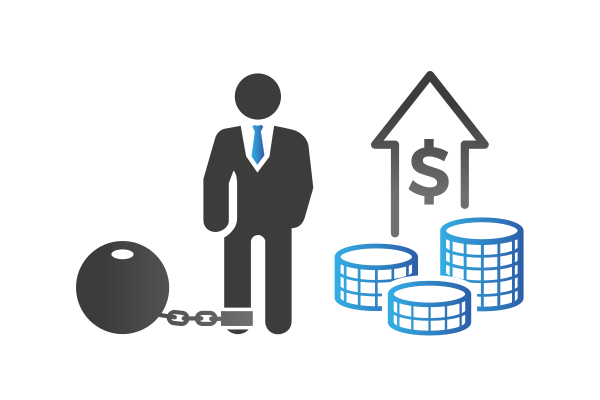
From a business point of view, it would make no sense to carry out transformation and migration to SAP S/4HANA by transferring all data and documents from the existing systems to the new environment but still keeping the legacy systems running in parallel to the new software generation. After all, continuing to run obsolete systems is one of the main reasons why many companies spend
80 percent of their overall IT budgets on operation. Often, 70 percent of that is for running old systems alone. The ideal division would be 60 percent for IT operations and 40 percent for innovation – permanently.
Read more
Another obstacle that’s at least as big is insufficient data quality following a migration. After all, digitalization is based on data. If the data is incorrect, highly automated processes between man and machine, as well as between machines, are impaired and error-prone. Analyses of incorrect data will lead to companies drawing wrong conclusions, which may have a fatal effect on the ongoing development of their business model. The transformation of their company to an Intelligent Enterprise would be in danger of failing.
Data harmonization is key to preventing overreliance on the legacy systems and reducing the data volume for the new application environment, while enabling an unrestricted and complete view of the data.
A further point is that continuing to run SAP legacy systems may expose companies to a legal risk if they have not been adapted to meet GDPR deletion requirements. However, this adaptation comes with a heavy technical and financial burden, assuming it is even possible. In addition, many legacy systems are exposed to cyber risks due to the lack or unavailability of the necessary security patches, maintenance and updates.
Solution
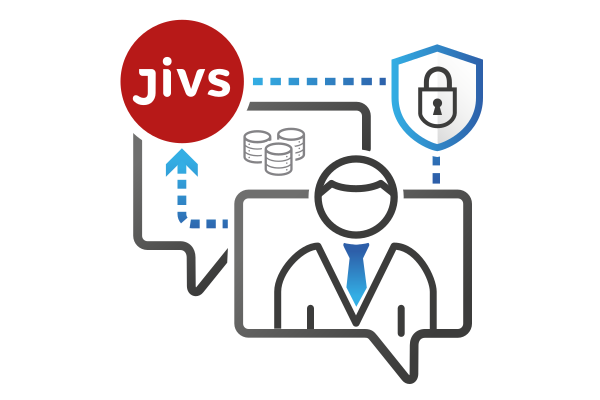
The solution to the challenges associated with migration to SAP S/4HANA is the system-independent management of the entire life cycle of legacy data and documents – forming a part of the destination environment after migration. Data Migration Services has developed the JiVS IMP Information Management Platform precisely for this purpose.
Read more
4.1. Data staging area
JiVS IMP generally acts as a central collection point and provisioning area or “data staging area” for company information. Data and its quality can be analyzed and optimized here, such as by duplicate cleansing, enrichment from other, business-relevant sources and harmonization. This is actually of essential importance – not just for migration projects, but also in all agile business scenarios such as mergers and acquisitions, digital transformation and big data along with the resulting digital business models and processes.
The JiVS IMP data staging area reveals its full benefit when migrating to the SAP S/4HANA and SAP C/4HANA, first and foremost by creating a harmonized master data structure which also incorporates the legacy data. In addition, it enables continued access to the historical data of fields that are obsolete in the new system, without the need for extensive value mapping.
4.2 Automation and rightsizing
JiVS IMP is an efficient and intelligent platform for the life cycle management of historical information. Above all, intelligent means that it is automated and – of particular importance for established SAP customers – integrated.
Automation involves removing as many of the manual steps as possible that are required for traditional approaches to suitably reduce the volume of data. Automation also means transferring data from the online database to a separate environment at the click of a button. The life cycle of the historical data and documents is also managed in this environment, from access through to optimization, compliance management and their ultimate deletion. In addition, with automation, this transfer of data at the click of a button incorporates existing archives as well.
Integrated means that this kind of environment for intelligent rightsizing uses and enhances the existing tools of the established SAP customers rather than replacing them. As a result, SAP offers unlimited support for this rightsizing approach and all the associated steps are executed in the online systems without interruption.
There is significant reduction potential. Automated and integrated rightsizing through a suitable and SAP-independent platform allows much stricter criteria for volume reduction to be applied. With automated copying of all existing data and documents from the online database, JiVS IMP enables the reduction potential to be determined based on the selected criterion. As the platform is integrated with SAP, its rightsizing cockpit uses and optimizes the ADK standard functions and indicates the reduction potential for each ADK object.
Customers can implement JiVS IMP in a separate data center or take advantage of public cloud offerings. Supported environments include Amazon Web Services, the Google Cloud Platform and Microsoft Azure. Customers can also choose from a number of common database management systems, such as IBM Db2, Oracle Database, Microsoft SQL Server or SAP IQ.
Customer benefits
Over 2,000 implementations worldwide have shown that this concept works. As it’s a Java-based platform, JiVS IMP is independent of the systems on which it runs. Consequently, there is no spare parts problem with the outdated hardware and the level of security is enhanced through regular security updates.
Read more
5.1. Massive data reduction
The JiVS IMP turbo loader enables massive reductions in data volume, reducing SAP relational databases by 85 percent. Companies can also reduce the data stored in ADK archives by at least 80 percent and then transfer it to the platform. In addition, the new systems can be kept permanently lean and can therefore be operated more cost-effectively by continuously moving information generated and processed there to JiVS IMP on a specific date, such as one year after generation. By storing and managing historical data on an in-memory database like SAP HANA or on JiVS IMP, the operating costs are reduced by a factor of 100 to 1,000. This is made possible by our innovative technology for the turbo transfer of ADK data to our platform, which takes anything from a few days to a maximum of several weeks, even for a compressed volume of 100TB – a process that could have taken several months in the past.
Up to 20TB of existing SAP data can also be transferred from legacy systems to JiVS IMP within one hour.
5.2. Migration into the future
Whether it’s greenfield, brownfield or bluefield, JiVS IMP supports any migration approach that customers choose. For this purpose, JiVS IMP follows the same business object-focused approach as conversion and migration tools from SAP (e.g. Migration Cockpit) or third-party vendors. This support is directly reflected at the JiVS IMP repository level. As a result, JiVS IMP is able to map the business objects of the legacy systems as well as the new software generations and their further developments at database level. Using JiVS IMP, auditors can display customer data and documents as they were created in SAP ECC 6.0. However, a customer adviser working with SAP S/4HANA receives a view of the customer in JiVS IMP, as if the customer had been created in the new software generation. Finally, life cycle management also means the ability to support future changes to business objects and completely new business objects.
5.3 The Intelligent Enterprise: resilient, flexible and individual
Greater resilience essentially means being able to respond better to changes. This requires the loose coupling of all areas of the IT stack, from the infrastructure to the data layer and the applications, and dynamically linking and combining these areas depending on the requirements.
The company’s IT is considered flexible when it is able to support a wide range of scenarios and helps to achieve several goals simultaneously. In other words, all short-term measures leaning towards greater resilience need to fulfill the sense and purpose of greater flexibility.
In the digital economy, companies will become increasingly differentiated through digital services. IT will play a permanent role in value creation. The vast majority of these developments will not be in the form of large application packages but instead will be functions and functionality that cloud native creates and will be provided as containers and microservices. As a result, they can be flexibly reused depending on the context. This is where flexibility moves seamlessly into individuality, which is the most valuable differentiating factor in the digital platform economy.
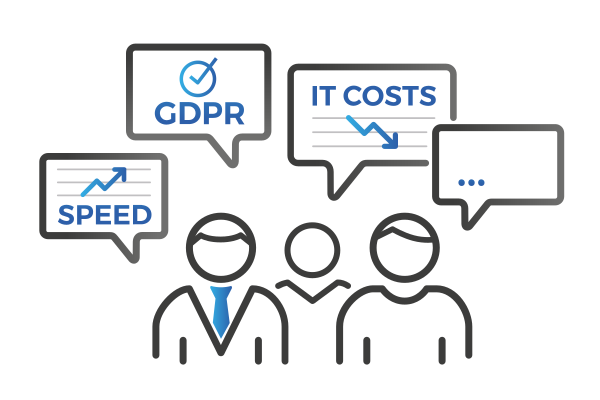
Companies can enjoy massive benefits by deploying our platform for information management JiVS IMP for the management of their historical data. The operating costs generally drop by 80 percent compared to the cost of continuing to run the legacy systems which can be completely closed down. At the same time, the transformation workload when migrating to SAP S/4HANA is halved and the overall operating costs are realistically reduced by 25 percent. Companies can also continuously optimize the quality of their data and support agile business scenarios more quickly and with less effort. JiVS IMP allows for greater legal and IT security, while also allowing companies to avoid the dilemma of cost optimization versus innovation.
5.4 Objective: the Composable Enterprise – loose coupling of data and applications
The Composable Enterprise can continue to re-compose and develop its structures and processes on the basis of coupled application modules, analysis functions and data packages in a way that optimizes both costs and resources, and thus can also respond quickly and resiliently to unexpected changes, including external shocks, without threatening its existence. A Composable Enterprise is resilient, flexible and individual. With our platform, we provide the necessary managed data fabric, thereby contributing towards the industrialization of IT.
Price and availability
JiVS IMP and the editions for SAP S/4HANA and SAP C/4HANA are available now. The functional scope and pricing are defined on a project-specific basis. Customers can choose to subscribe to the platform’s functionality as a service, enabling them to transfer capital expenditure to operating expenditure (OPEX).
